

Specialty contact lenses have transformed the management of irregular corneas, ocular surface disease, high refractive error, and complex visual needs, while advanced technology is reshaping how practitioners diagnose, fit, monitor, and manage patients who require more than conventional contact lenses. The integration of this technology (ie, imaging, impression-guided design, empirical lens ordering, artificial intelligence [AI], and smart contact lens platforms) into specialty contact lens practice offers significant clinical and operational benefits. By streamlining the fitting process, practitioners can reduce chair time, minimize the number of remakes or readjustments, and achieve patient satisfaction more rapidly. These advantages are particularly important in scleral lens, orthokeratology, and rigid gas permeable (GP) lens fitting, where lens customization is often necessary to optimize comfort, vision, and long-term physiologic ocular health by reducing mechanical stress, minimizing hypoxia, and supporting more accurate monitoring over time.
Technology also creates an opportunity for practice growth. In addition to providing a higher level of individualized care, practices that incorporate advanced contact lens technology can differentiate themselves from others and increase referrals. Practitioners may also be able to justify higher professional fees for specialty contact lens services.
Image-Guided and Impression-Guided Lens Design
One of the most significant advances in specialty contact lens care is image-guided technology. Modern corneal topography, tomography, anterior-segment optical coherence tomography (OCT), profilometry, and scleral shape measurement devices allow practitioners to capture detailed ocular surface data and translate that information into empirical lens designs. This is particularly valuable for orthokeratology, rigid GP, and scleral lenses where small changes in sagittal depth, landing zone alignment, optic zone diameter, and peripheral curves can significantly affect lens performance.
Image-guided fitting can reduce reliance on large diagnostic lens sets and repeated in-office trial lens evaluations because practitioners can design lenses based on objective and precise measurements of corneal and scleral shape. These measurements can improve the starting point of the lens fit and reduce the number of modifications needed to achieve an optimal outcome. In scleral lens fitting, for example, scleral asymmetry and toricity can be addressed more accurately when the design is based on measured ocular shape rather than estimation alone.
Partnerships between imaging companies and contact lens manufacturers are also advancing the field of specialty contact lenses. When imaging data can be transferred directly to a manufacturer, the lens design process becomes more efficient and collaborative. These partnerships allow for increasingly customized lens designs and improved communication among the practitioner, manufacturer, and laboratory consultant. As interoperability improves, the future of specialty lens fitting will likely become even more data driven.
Impression-guided technology represents another important pathway toward customization. By creating a physical or digital impression of the ocular surface, highly customized scleral lens designs can be manufactured to match the unique contours of the eye. This approach can be especially useful for patients who have had glaucoma or retinal surgery or those with highly irregular ocular surfaces, severe ocular surface disease, or complex anatomy that is difficult to fit with conventional or semicustom designs.
Smart Contact Lenses
Smart contact lenses are emerging as potential diagnosis, monitoring, and treatment platforms beyond vision correction. These lenses incorporate miniature electronic devices, wireless sensors, microfluidic systems, or drug-delivery mechanisms into contact lens materials. Their applications may include early detection and monitoring of ocular diseases such as dry eye disease, glaucoma, diabetic retinopathy, and systemic inflammatory conditions.
Smart contact lenses can potentially record biomarkers and physical properties of the eye, such as intraocular pressure (IOP), glucose levels, lactate, tear film composition, inflammatory markers, temperature, and ocular surface changes. In some instances, information may be transmitted wirelessly to an external device such as a smartphone, medical monitoring platform, or clinician-facing dashboard and creates the possibility of remote and continuous disease assessment outside the clinic.
This concept is particularly compelling because a single in-office measurement of an ocular disease may not always reflect a patient’s true disease state over time. For example, IOP varies throughout the day and night, dry eye signs and symptoms fluctuate with environment and activity, and tear biomarkers may change with inflammation or treatment response. Smart contact lenses could help capture more dynamic data and support more individualized decision-making.
However, this technology also faces significant challenges with biocompatibility, comfort, manufacturing complexity, scalability, oxygen transmission, wettability, and visual clarity. Many studies remain limited by small sample sizes and short wear periods, often less than 72 hours. Much of the research is still in early stages, including in vitro studies or animal models, and translation into routine clinical care will require larger human studies and long-term safety data.
Sensor integration is another major challenge because devices must be embedded without obstructing vision, disrupting lens movement, compromising comfort, or altering the ocular surface environment. Sensors may also be affected by temperature, humidity, tear composition, blinking, and mechanical forces. In addition, patient compliance with contact lens hygiene remains essential. Even the most advanced lens technology will not eliminate the need for safe wear and follow-up care.
There are also commercial and regulatory barriers. US Food and Drug Administration (FDA) approval, manufacturing scalability, cost, insurance coverage, and patient access will influence how quickly these technologies move from research settings to clinical practice. Privacy and data security are also critical considerations. Because smart lenses may transmit patient health information, data encryption, secure storage, informed consent, and ethical use of collected information must be central to development. Based on these barriers, the question arises: How practical is the application of smart contact lenses in a real-world clinical setting?
Biomaterials for Smart Contact Lenses
Smart contact lenses rely on biomaterials that can combine optical clarity, comfort, oxygen transmission, biocompatibility, flexibility, and electronic function. Among other conductive materials that are under investigation, graphene has received considerable attention because of its strength, transparency, conductivity, flexibility, and biocompatibility. These properties make it an attractive option for integrating sensing capabilities into contact lenses while preserving visual function. Conductive coatings may also help shield the ocular surface from electromagnetic effects and may play a role in reducing dehydration or improving surface performance, although additional research is needed to determine long-term clinical relevance.
In addition to the materials that are central to their success, smart contact lenses must remain comfortable and safe while supporting electronic or sensing functions. They must also maintain stable optics, adequate oxygen permeability, resistance to deposits, durability with handling, and compatibility with tear film dynamics. The future of smart lens development will depend on close collaboration among doctors and scientists across the field.
Intraocular Pressure Monitoring
One of the most studied applications of smart contact lenses is IOP monitoring. Glaucoma management is limited by the fact that IOP is typically measured during office hours, though pressure may fluctuate throughout the day and night. Smart contact lenses may provide a more continuous assessment of pressure-related ocular changes and, thereby, improve early detection and management of glaucomatous patients.
There are 3 major approaches to IOP monitoring in smart contact lenses: capacitive sensors, strain sensors, and microfluidic sensors.
Capacitive sensors use a dielectric layer between electrodes that conforms to corneal curvature. Elevated IOP causes compression changes to the shape of the lens, which changes the radius of curvature of the cornea. Wireless hydrogel-based smart contact lenses for real-time IOP monitoring have been explored, including designs described by Zhu et al.1 Other systems, such as cantilever circuit designs, have combined IOP monitoring with ocular drug delivery.1
Strain sensors detect mechanical changes in the lens material and convert those changes into electrical signals. These systems can provide high sensitivity while maintaining flexibility, transparency, and biocompatibility. One example is the Sensimed Triggerfish, an FDA-approved smart contact lens that is designed for 24-hour IOP-related monitoring. Although it has demonstrated clinical safety, interpretation of the data can be challenging because the output does not directly represent conventional IOP measurements in millimeters of mercury. Instead, it reflects ocular dimensional changes associated with pressure fluctuations.
In microfluidic systems, IOP-induced corneal deformation displaces fluid within microchannels. The movement of fluid correlates with pressure-related changes and may be tracked visually or through smartphone-based systems. Microfluidic systems have the advantage of not requiring a power source, but they may carry risks such as fluid leakage, channel blockage, irritation, and mechanical instability. As a result, these sensors have low sensitivity and room for error, especially in dark environments, which can be overcome if the data are transmitted to an antenna system instead. Prototypes described by Yuan et al2 and Agaoglu et al3 demonstrate the potential of this approach, including integration with drug-delivery systems in which IOP changes or blinking may trigger medication release through microchannels.
A recent innovative design method published by Xiao et al4 proposes a smart contact lens design based on a resistive pressure system. The smart lens includes a multilayer sandwich resistive sensor with a conductive polymer layer that allows good user visibility and an alcohol layer to improve stretchability. As IOP increases, the sensor stretches, which causes a change in the conductive polymer layer and subsequently a change in resistance. In both in vivo and in vitro models, the device showed high sensitivity, transmittance, and biocompatibility.
Glucose, Lactate, and Tear Biomarkers
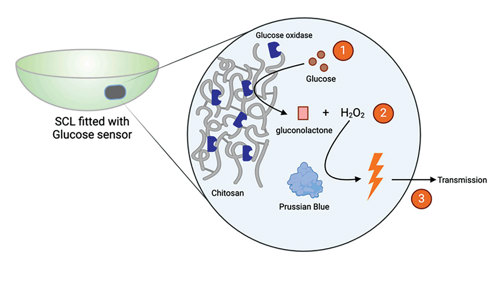
Smart contact lenses have also been investigated for systemic and ocular biomarker monitoring, specifically with glucose. One such lens has a glucose biosensor with embedded electrodes coated with glucose oxidase and Prussian blue to support electron transfer with wireless data transmission (Figure 1).5,6 Although tear glucose monitoring remains complex due to differences between blood and tear glucose levels, the concept continues to drive research in noninvasive metabolic monitoring.
Thomas et al7 explored lactate sensors using lactate oxidase in smart contact lenses, which may have applications for athletes, ischemic conditions, and metabolic assessment. Tear lactate levels specifically may provide useful information about ocular surface physiology, tissue metabolism, or systemic exertion, although clinical translation remains early.
In the future, smart contact lenses may be able to monitor inflammatory markers, osmolarity, pH, electrolytes, cytokines, or other tear biomarkers to help practitioners better understand disease activity and treatment response in real-time and longitudinally. This capability could be particularly useful in dry eye disease, ocular allergy, autoimmune disease, postoperative inflammation, and contact lens-related complications.
Drug-Delivery Contact Lenses
Drug delivery is another promising application of advanced contact lens technology because these lenses might provide a platform for more sustained and controlled drug release that is limited with traditional topical ophthalmic medications. This concept is not new; think, for example, of the off-label use of autologous serum tears within a scleral lens reservoir for ocular surface disease management.
Sun et al8 developed a contact lens that releases levofloxacin and diclofenac in response to elevated reactive oxygen species at areas of ocular inflammation, and Kumara et al9 described contact lens systems that are designed to deliver latanoprost or dual latanoprost and timolol therapy when triggered by lysozyme in tears. This type of responsive system suggests a future in which contact lenses may both monitor disease activity and adjust drug release based on fluctuating inflammatory status.
The potential benefits are significant. Controlled drug delivery may improve patient compliance, reduce dosing burden, maintain more consistent therapeutic levels, and decrease the risk of undertreatment or overuse. In postoperative care, antibiotic and anti-inflammatory drug-delivery lenses could simplify treatment regimens. In dry eye disease, contact lens-based delivery could support more continuous therapy for patients who struggle with frequent drop instillation. In glaucoma care, this type of drug delivery could improve patient compliance and, therefore, reduce the risk of disease progression as well as vision loss. If successful, these platforms could address adherence to chronic topical therapy, which is one of the major challenges in glaucoma care.
Artificial Intelligence and Contact Lenses
In contact lens development, AI-driven simulations may help identify new materials, surface coatings, and lens designs that have enhanced oxygen permeability, comfort, wettability, and biocompatibility. Machine-learning models can analyze complex interactions among lens material properties, tear film behavior, corneal physiology, and patient-reported comfort, which may accelerate innovation and reduce the time required to evaluate new designs.
AI may also improve design optimization by modeling individualized lens geometry, centration, movement, sagittal depth, landing zone alignment, and stability. In scleral lens fitting, AI-assisted interpretation of imaging may help practitioners select initial lens parameters more accurately. It also may assist with treatment zone centration, corneal reshaping prediction, and myopia control outcomes in orthokeratology. Automated fitting tools, virtual try-on platforms, and smart fitting software may reduce chair time and decrease dependence on large diagnostic lens inventories.
These systems are not intended to replace clinical judgment, but they may enhance efficiency and support more consistent fitting outcomes. AI can help synthesize large amounts of data quickly, which allows the practitioner to focus on individualized, clinical interpretation and care.
AI may also play a major role in smart contact lenses: Biosensing platforms will generate large volumes of data10 that AI can help interpret. It also can identify patterns, detect clinically meaningful changes, and generate alerts for patients or providers. Combined with telehealth platforms, smart lenses may eventually support remote monitoring and more proactive disease management.
Patient monitoring and compliance may also benefit from AI, especially when integrated with existing health metric monitoring devices. Apps and sensors could help track wear time, replacement schedules, hygiene habits, symptoms, and treatment adherence. AI chatbots and virtual assistants may support patient education, answer common questions, reinforce care plans, and encourage timely follow-up. These tools may be especially useful for patients who wear orthokeratology, scleral, or therapeutic lenses that require detailed handling and compliance.
Challenges and Ethical Considerations
Despite the promise of technology, several challenges remain. Data privacy and security are central concerns, especially as lenses and apps collect health information. Regulatory pathways must ensure safety, efficacy, accuracy, and reliability, while eyecare professionals will require training to interpret new data streams, integrate technology into workflows, and explain results to patients.
Cost and access must also be considered because insurance coverage may not keep pace with innovation. If these technologies are not implemented thoughtfully, they could widen disparities in access to advanced eye care.
Clinical judgment remains essential. Technology can improve precision, but it cannot replace the practitioner-patient relationship or provider intuition. The most successful implementation will occur when advanced tools are used to enhance, rather than depersonalize, care.
The Future of Specialty Contact Lens Technology
The future of specialty contact lenses will be increasingly personalized, data-driven, and interdisciplinary. As optometry, ophthalmology, engineering, materials science, and data science continue to intersect, specialty contact lenses will evolve beyond optical correction alone. They will become platforms for diagnosis, monitoring, treatment, and personalized care.
However, AI and advanced technology are not replacing practitioners. They are empowering us to fit more precisely, monitor more intelligently, treat more effectively, and serve patients more efficiently. The goal remains unchanged: to improve vision, protect ocular health, enhance quality of life, and deliver care that is both scientifically advanced and deeply human, all with the support of technology.
References
- Zhu H, Yang H, Zhan L, Chen Y, Wang J, Xu F. Hydrogel-based smart contact lens for highly sensitive wireless intraocular pressure monitoring. ACS Sens. 2022;7(10):3014-3022. doi:10.1021/acssensors.2c01299
- Yuan M, Liu Z, Wu X, et al. High-sensitive microfluidic contact lens sensor for intraocular pressure visualized monitoring. Sens Actuators A Phys. 2023;354:114250. doi:10.1016/j.sna.2023.114250
- Agaoglu S, Diep P, Martini M, Kt S, Baday M, Araci IE. Ultra-sensitive microfluidic wearable strain sensor for intraocular pressure monitoring. Lab Chip. 2018;18(22):3471-3483. doi:10.1039/c8lc00758f
- Xiao T, Zhang H, Takamatsu T, et al. Ultra-sensitive real-time monitoring of intraocular pressure with an integrated smart contact lens using parity-time symmetry wireless technology. npj Flex Electron. 2026;10:4. doi:10.1038/s41528-025-00507-3
- Wu KY, Dave A, Carbonneau M, Tran SD. Smart contact lenses in ophthalmology: innovations, applications, and future prospects. Micromachines (Basel). 2024;15(7):856. Doi:10.3390/mi15070856.
- Park J, Kim J, Kim S-Y, et al. Soft, smart contact lenses with integrations of wireless circuits, glucose sensors, and displays. Sci Adv. 2018;4(1):eaap9841. doi:10.1126/sciadv.aap9841
- Thomas N, Lähdesmäki I, Parviz BA. A contact lens with an integrated lactate sensor. Sens Actuators B: Chemical. 2012;162(1):128–134. doi:10.1016/j.snb.2011.12.049
- Sun R, Zhang J, Chen X, et al. An adaptive drug-releasing contact lens for personalized treatment of ocular infections and injuries. J Control Release. 2024;369:114–128. doi:10.1016/j.jconrel.2024.03.040
- Kumara BN, Shambhu R, Shim Y-B, Prasad KS. Lysozyme activated co-delivery of latanoprost–timolol from mucoadhesive chitosan nanocomposite to manage glaucoma. RSC Pharm. 2024;1(3):548-569. doi:10.1039/d4pm00031e
- Araci IE, Agaoglu S, Lee JY, et al. Flow stabilization in wearable microfluidic sensors enables noise suppression. Lab Chip. 2019;19(22):3899-3908. doi:10.1039/c9lc00842j