


Roivant and Priovant Therapeutics announced positive results from the phase 3 CLARITY program evaluating brepocitinib in non-infectious uveitis (NIU). Brepocitinib met the primary endpoint for both the CLARITY-1 and CLARITY-2 studies. Brepocitinib also achieved statistically significant and clinically meaningful benefit on all key secondary endpoints, including measurements of sustained steroid-free quiescence at week 48, chorioretinal vascular leakage, resolution of macular edema, and patient-reported visual functioning. These results were achieved despite a substantially more aggressive steroid taper than precedent NIU trials, according to a press release issued by Roivant.
The CLARITY program enrolled 371 patients across 2 identical studies, CLARITY-1 and CLARITY-2. Patients were randomized 1:1 to once-daily brepocitinib 45 mg or placebo for a 48-week double-masked treatment period. All patients received an 8-week oral corticosteroid regimen of 60 mg/day for 2 weeks followed by a mandatory 6-week steroid taper to zero. The primary endpoint was time to treatment failure, assessed from week 6 through week 48.
Time to treatment failure in CLARITY-1 and CLARITY-2 (Kaplan-Meier estimates, brepocitinib vs placebo) is captured below:

Brepocitinib demonstrated consistent benefits in preventing treatment failure across key subgroups, including intermediate, posterior, and panuveitis; patients with and without prior TNFi experience; and multiple etiologies of uveitis, including idiopathic disease, birdshot chorioretinopathy, and sarcoidosis.
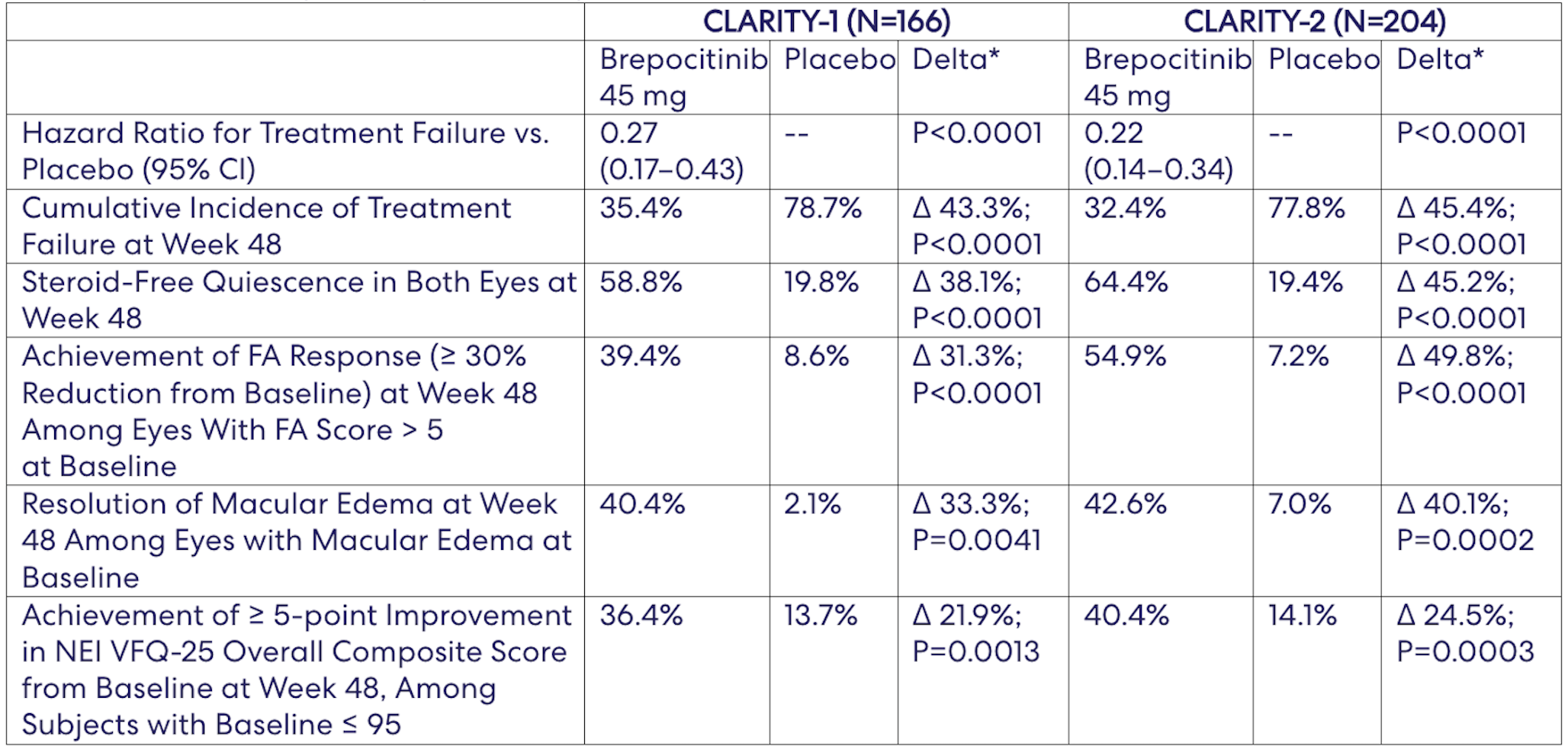
Pre-specified multiplicity-controlled secondary endpoints in the CLARITY trials included sustained steroid-free quiescence, improvement in chorioretinal vascular leakage as assessed through wide-field fluorescein angiography, resolution of macular edema, and improvement in patient-reported visual functioning (NEI VFQ-25 overall composite score).
Results on the primary and key secondary endpoints are captured below:
According to the press release, brepocitinib was generally well tolerated during the treatment period. Most events were mild or moderate in severity, and only 3% of participants discontinued treatment due to an AE. The observed safety profile in the trials was consistent with the known safety profile of brepocitinib, with no new safety signals observed.
Priovant said it intends to file a supplemental new drug application for brepocitinib for treatment of NIU in the first half of calendar year 2027. OM