

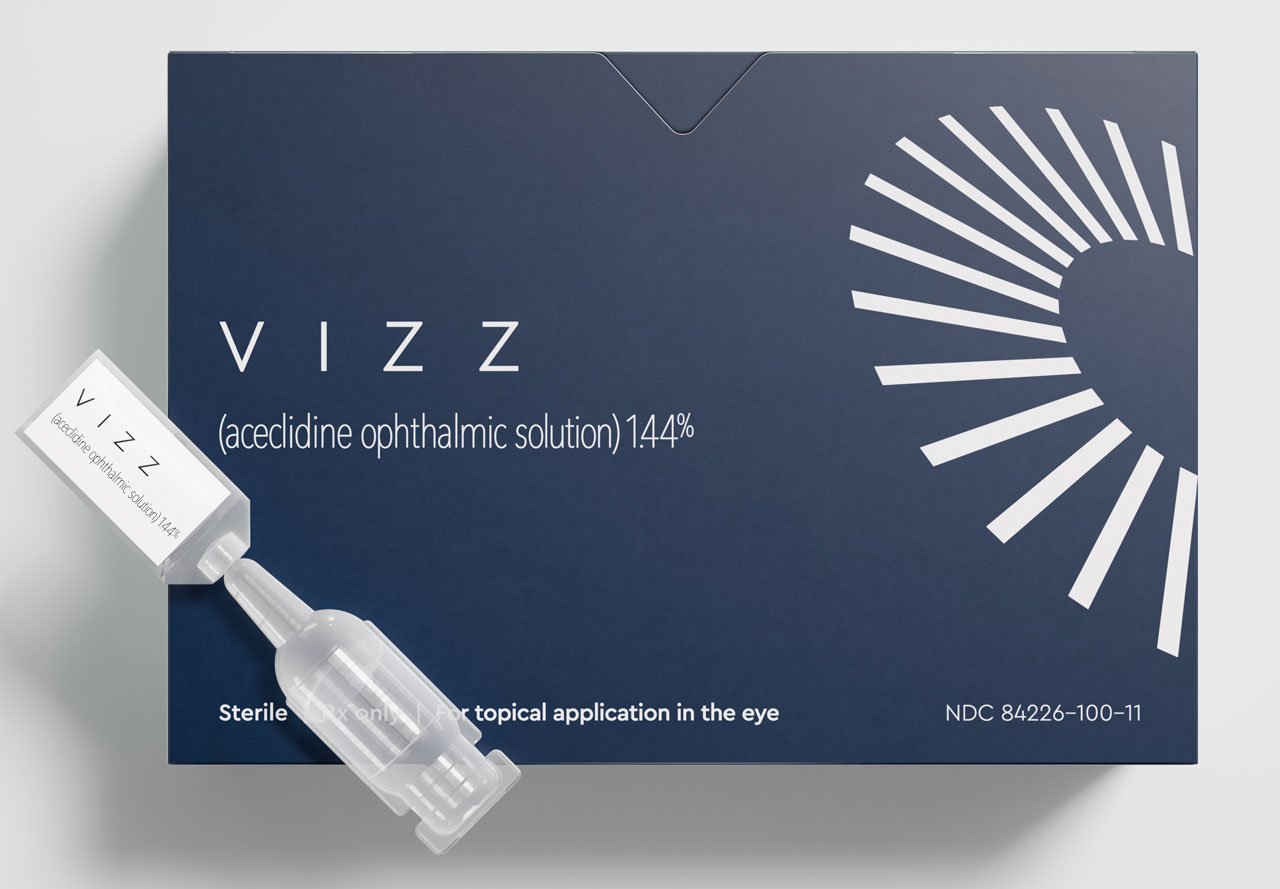
Kaleb Abbott, OD, MS, FAAO, assistant professor, Department of Ophthalmology at the University of Colorado Anchutz School of Medicine, in Aurora, Colorado, says if you take care of patients, they will take care of you. And for him, this has been evident by adding Vizz (aceclidine ophthalmic solution) 1.44%, from Lenz Therapeutics, to his presbyopia treatment armamentarium.
“When you truly change a patient’s life, they tell their family and friends how much this presbyopia drop has improved their quality of life—and that becomes a powerful practice builder,” he says. “It leads to more referrals and increased word-of-mouth about the care you provide.”
Vizz is a once-daily predominantly pupil-selective miotic eye drop that improves near vision within 30 minutes and lasts up to 10 hours with minimal ciliary muscle stimulation, according to Lenz Therapeutics. Specifically, it contracts the iris sphincter muscle, resulting in a sub-2 mm pupil that extends depth of focus without causing a myopic shift.
Like Dr. Abbott, Jeffry D. Gerson, OD, FAAO, Grin Eye Care, a multi-location practice in Kansas, and Shane R. Kannarr, OD, Kannarr Eye Care, in Pittsburg, Kansas, agree Vizz offers patient and practice value.
Patient Value
Dr. Abbott says his patients “love” the hassle-free vision Vizz provides, in that they no longer have to wear reading glasses. He emphasizes that the benefit goes beyond functional vision—it also impacts how patients feel about their appearance. “For many patients, it’s more than just seeing better. It’s about looking like themselves again,” he explains. “Some use Vizz simply to avoid the ‘readers on top of the head’ look.”
Dr. Kannarr adds that Vizz provides functional vision in many cases. “The miotic pupil creates a clear range of vision—distance, intermediate and near for many of our patients allowing them to function seamlessly at all distances throughout their day,” he says.
Dr. Gerson explains that Vizz changes depth of focus, which is different than the magnification that traditional readers gives us. “If somebody is using Vizz and also puts on reading glasses, they will still be able to see up close,” he says.
Dr. Gerson also relays that Vizz offers his patients who wear contact lenses a complementary solution. “I say to those patients ‘what if you wore contacts for distance and this was your answer for your near vision?’ So far, the reception from patients has been positive, and they also like that they will know within 30 minutes whether it’s going to work for them.”
Practice Value
According to Dr. Gerson, a fairly high percentage of people, once they need bifocals, drop out of contact lenses or assume they can’t get into contact lenses, so never try. “There’s a ton of lost contact lens revenue in the presbyopic group,” he explains. “Vizz offers something to keep people in contact lenses, even if the lenses are not multifocal. Keeping patients in regular contact lenses is better for patients because that’s what they want and better for the practice because it generates revenue. With Vizz, there are more contact lens (modality) options that can work.”
For Dr. Kannarr, when providers choose to offer patients new options for difficulties they’ve had, not only does doing so provide patient satisfaction but it creates referrals. “Patients feel tied to your office because you offered them a new solution, like Vizz. Also, when doctors tailor solutions to specific patient needs it engages the practitioner, which is infectious and spreads throughout the office, and the patient feels that sense of excitement as well.”
Managing Patient Expectations
To get patient buy-in to Vizz, those interviewed stressed the importance of managing patient expectations; specifically mentioning the possibility of some redness or burning upon instillation and dimmed vision. Those interviewed also say these experiences are mild and self-resolving. OM